Observe
Build a timestamped 3D history from prior RGB-D observations.
From remembered observations to predictive belief — and from belief to evidence-driven action.
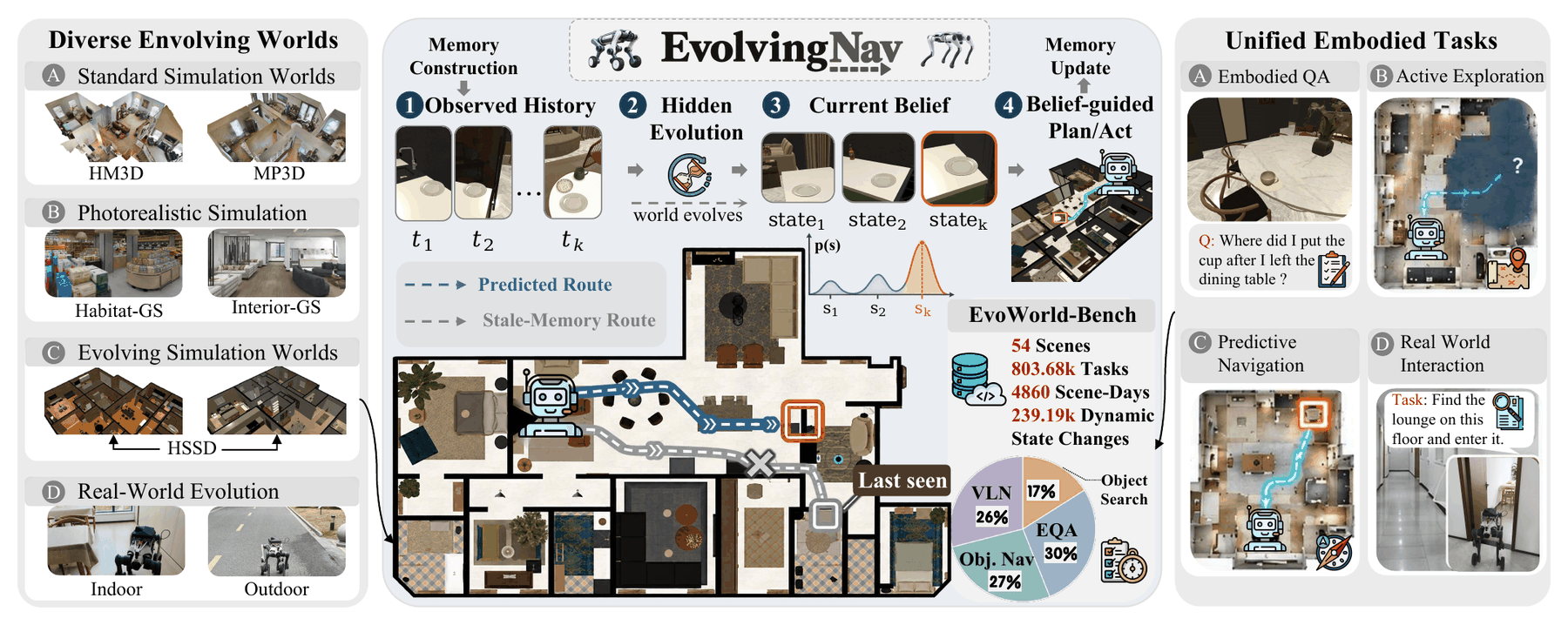
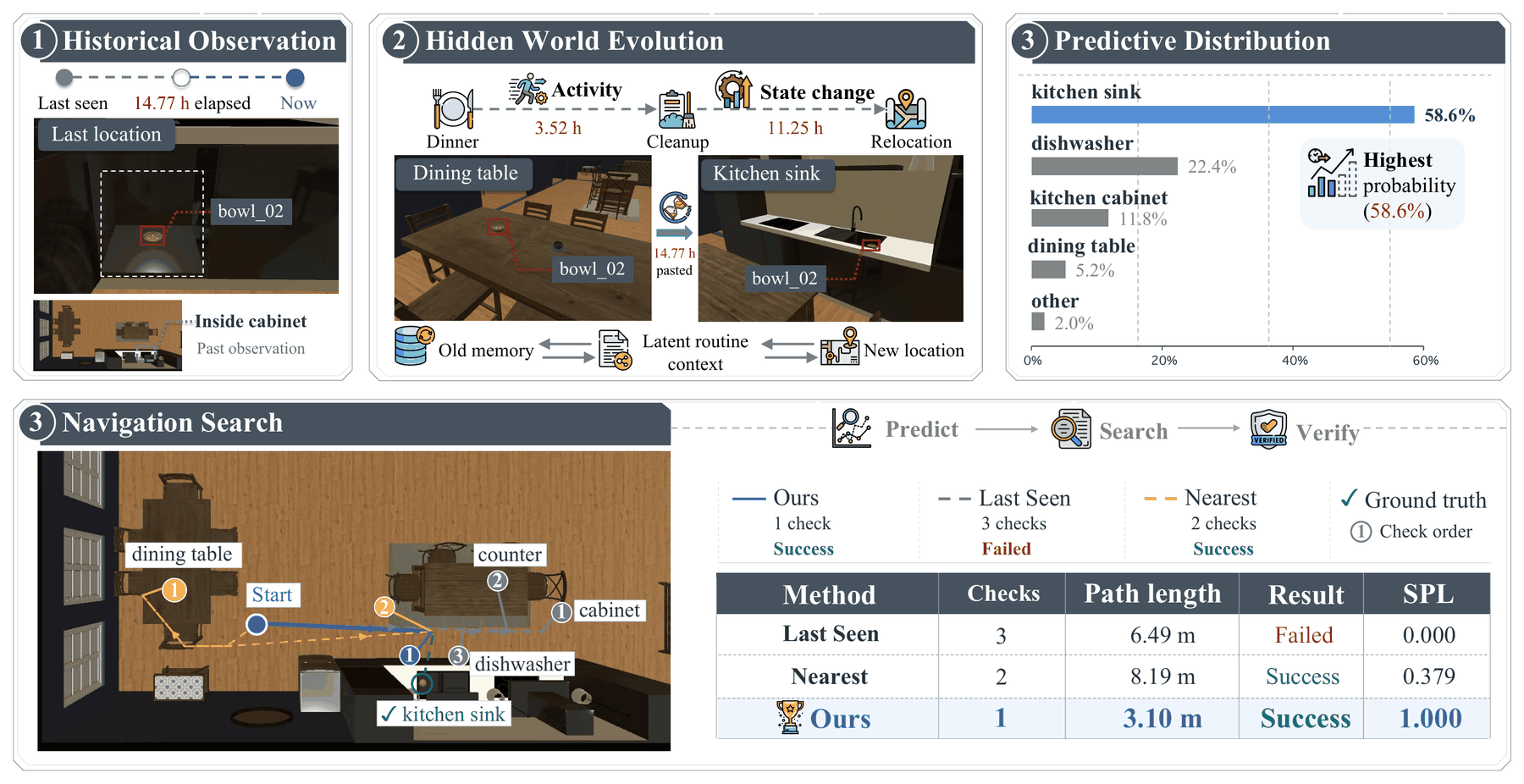
EvolvingNav treats navigation as an evidence loop: predict what will still be true at arrival, inspect only when the observation can change the decision, and revise the memory when the world disagrees.
Build a timestamped 3D history from prior RGB-D observations.
Forecast persistence and relocation at each candidate arrival time.
Use visibility-aware evidence to test the leading hypothesis.
Revise belief, reopen plausible candidates, and replan.
Persistent embodied agents must act from memories that can become stale: objects move while the agent is away, continue evolving during navigation, and may remain hidden even after an inspection. Existing methods do not jointly account for this continued hidden-world evolution and visibility-conditioned belief revision.
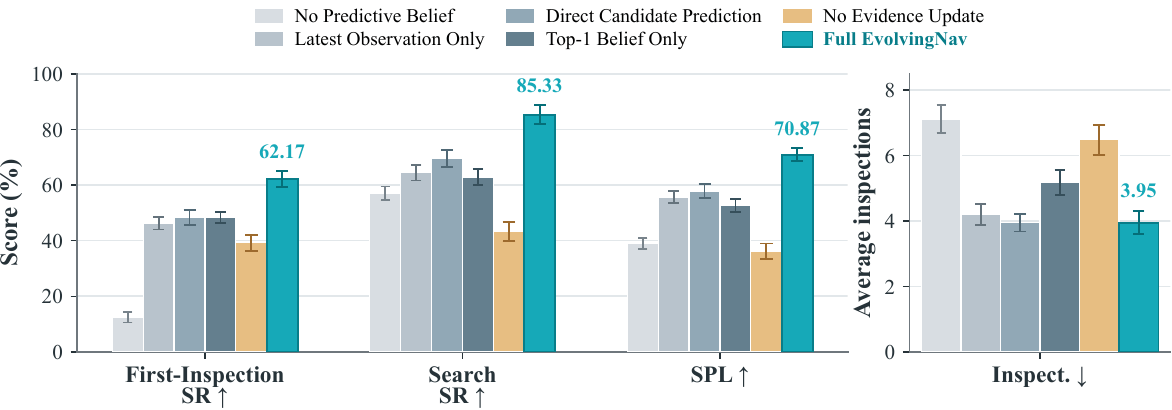
We introduce EvolvingNav, which turns timestamped 3D histories into a persistence–relocation belief over the current world. Its event-driven filter forecasts object state at candidate arrival times, invokes a frozen zero-shot vision-language model only when new RGB-D evidence is informative, and replans when evidence invalidates a candidate. We also introduce EvoWorld-Bench, a 54-scene benchmark with 803.68K tasks. EvolvingNav improves first-inspection decisions, budgeted search, and recovery, with the largest gains when environmental change has learnable regularity.
EvolvingNav represents each remembered entity with a timestamped 3D history and a factorized belief: a persistence term estimates whether the last observed state remains valid, while a relocation term distributes probability over plausible destinations. Instead of predicting only at query time, the planner forecasts the belief at each candidate’s estimated arrival time.
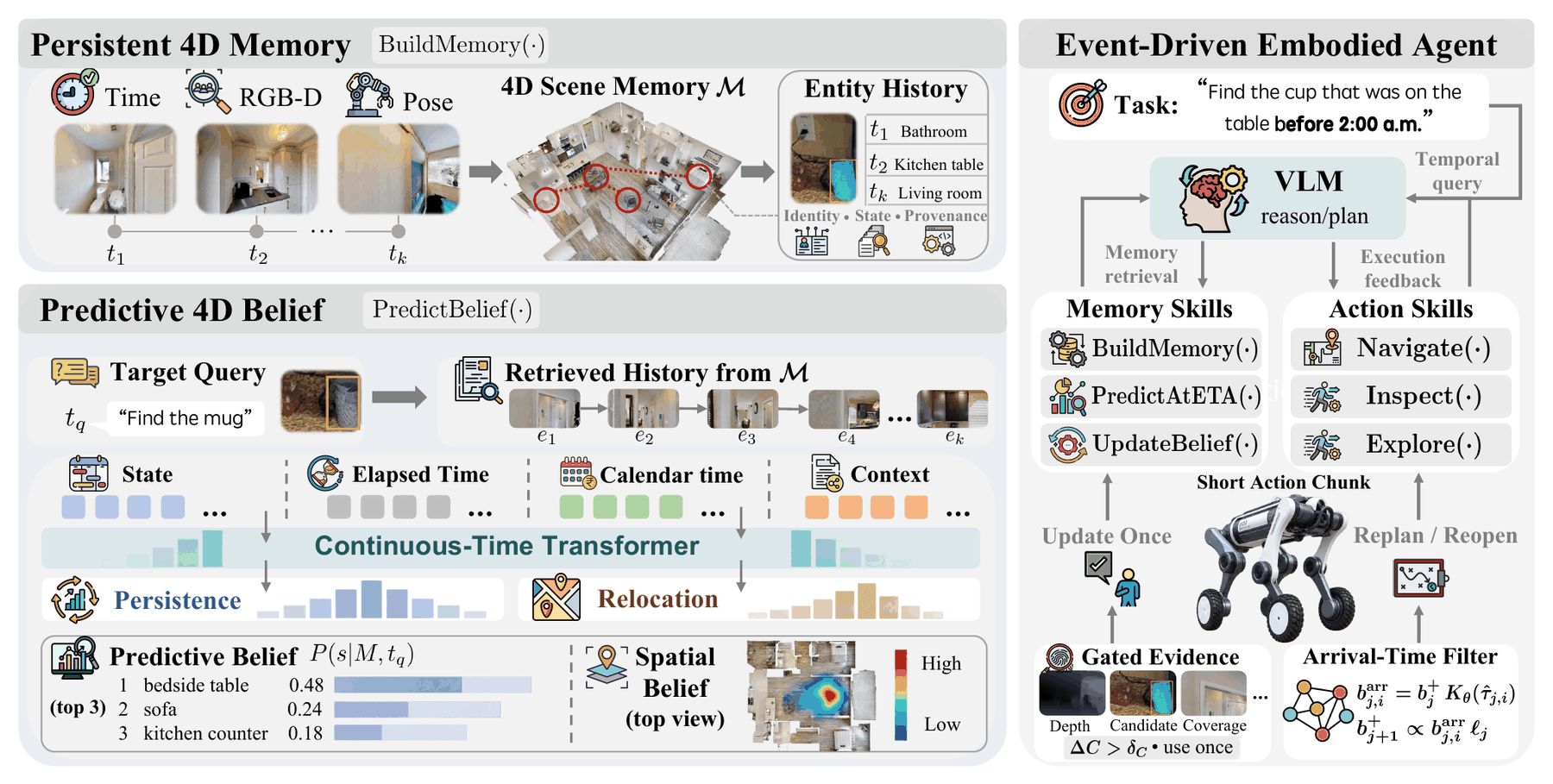
Execution proceeds in short action chunks. After each informative observation, the posterior is revised, invalidated candidates are suppressed, and previously rejected candidates may be reopened when time or evidence makes them plausible again.
timestamped history → arrival-time belief → short-horizon action → visibility-qualified evidence → replan
Explore a real HSSD scene from above. Follow the quadruped’s inspection route and see how new evidence changes an illustrative belief over object locations.
Follow the belief. Gather new evidence.
Scene images are captured in Habitat-Sim from HSSD. Object markers, probabilities and inspection outcomes illustrate the method; they are not measured model outputs. Scene provenance ↗
EvoWorld-Bench evaluates navigation when the world changes between observations and may continue changing while the agent acts. The latest release contains 54 scenes and 803.68K executable tasks, with persistent temporal histories, causal observability, controlled dynamics, and held-out transfer settings.
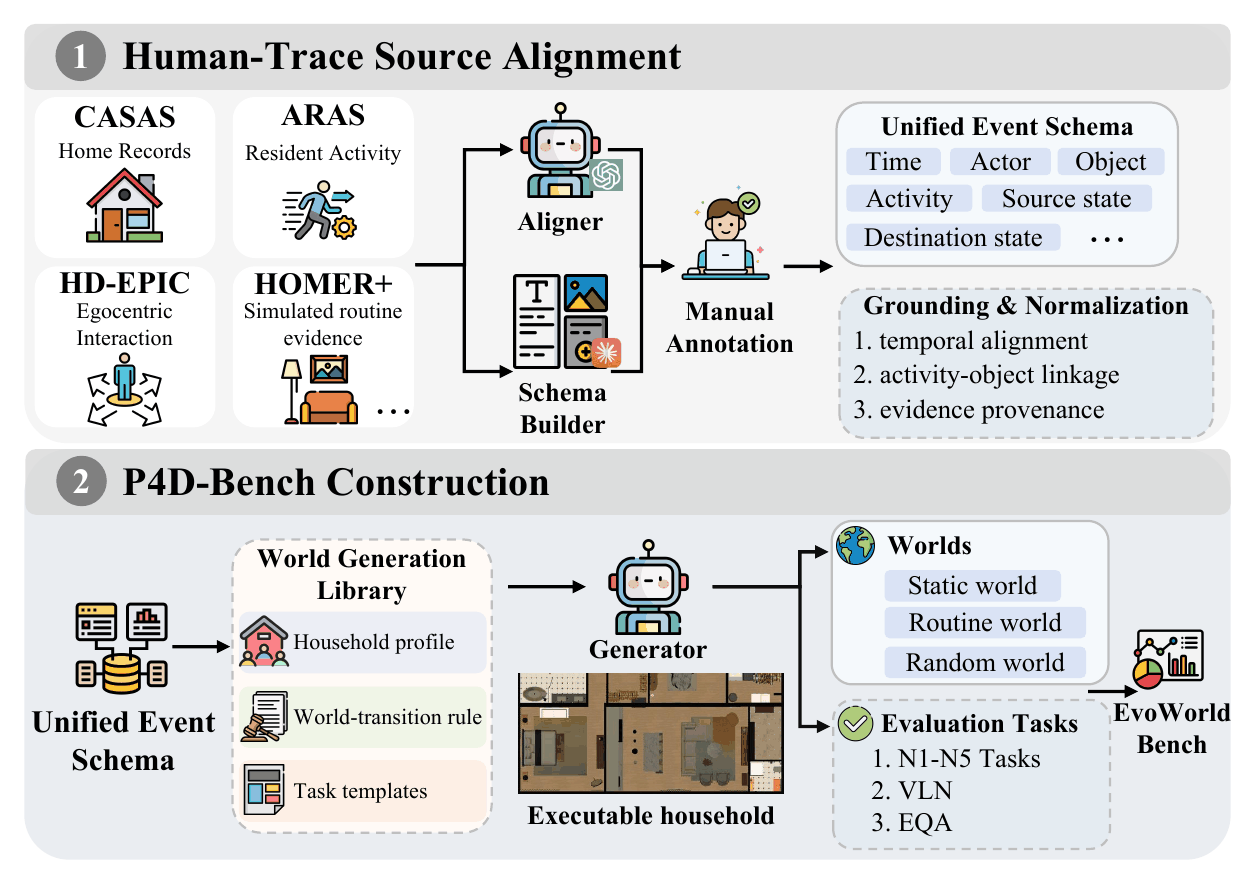
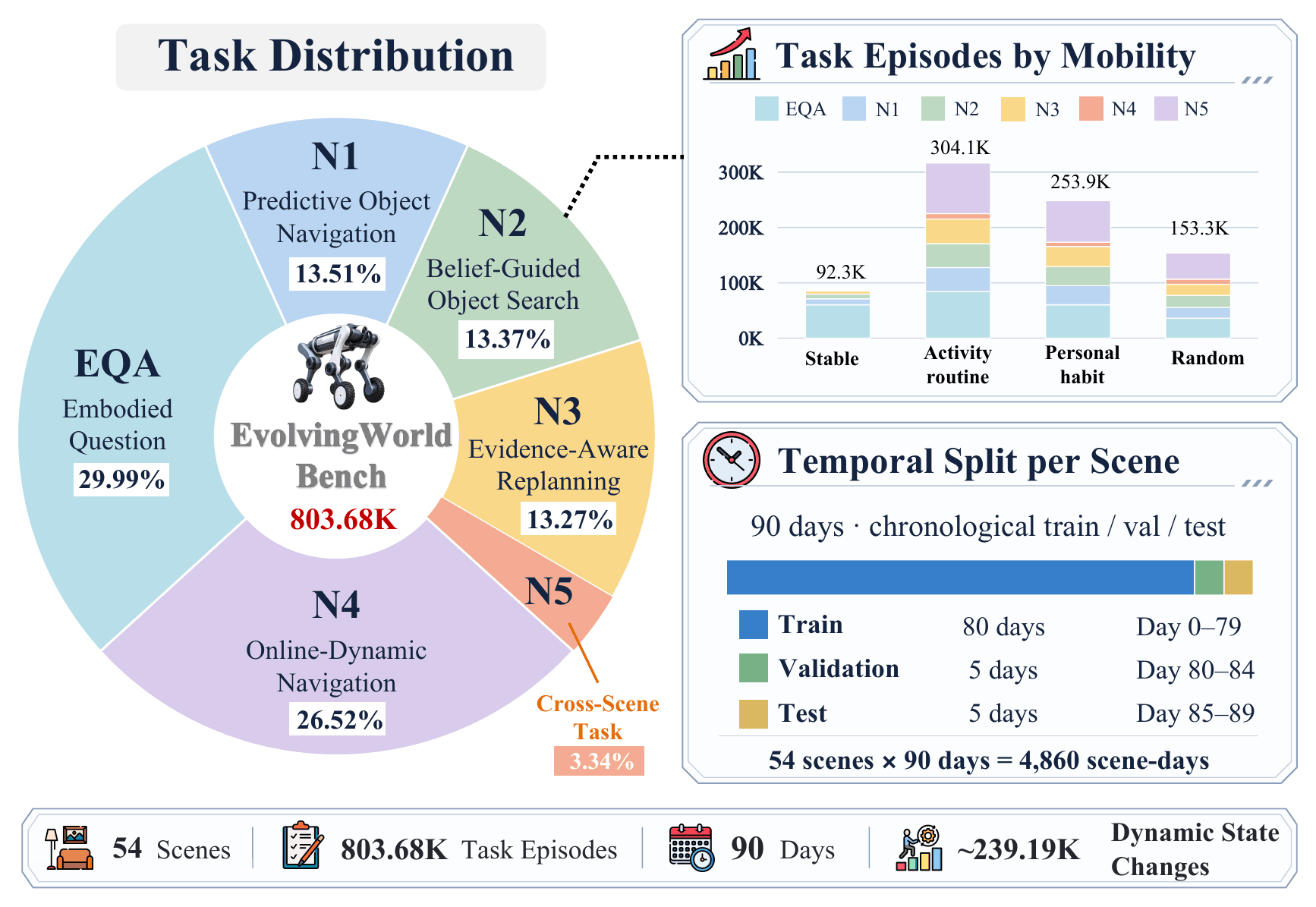
EvolvingNav improves both the first destination selected from stale memory and the ability to recover within a search budget. It transfers across FindingDory, GOAT-Bench, EvoWorld-Bench, and physical LYNX M20 trials.
| Method | FindingDory HL-SR ↑ | GOAT-Bench SR ↑ | EvoWorld First-Inspection ↑ | EvoWorld Search SR ↑ | EvoWorld SPL ↑ |
|---|---|---|---|---|---|
| DynaMem | 30.30 | 14.54 | 45.33 | 71.94 | 56.83 |
| EvolvingNav (ours) | 53.22 ± 3.87 | 35.43 ± 2.16 | 61.32 ± 3.24 | 86.18 ± 2.07 | 70.15 ± 1.74 |
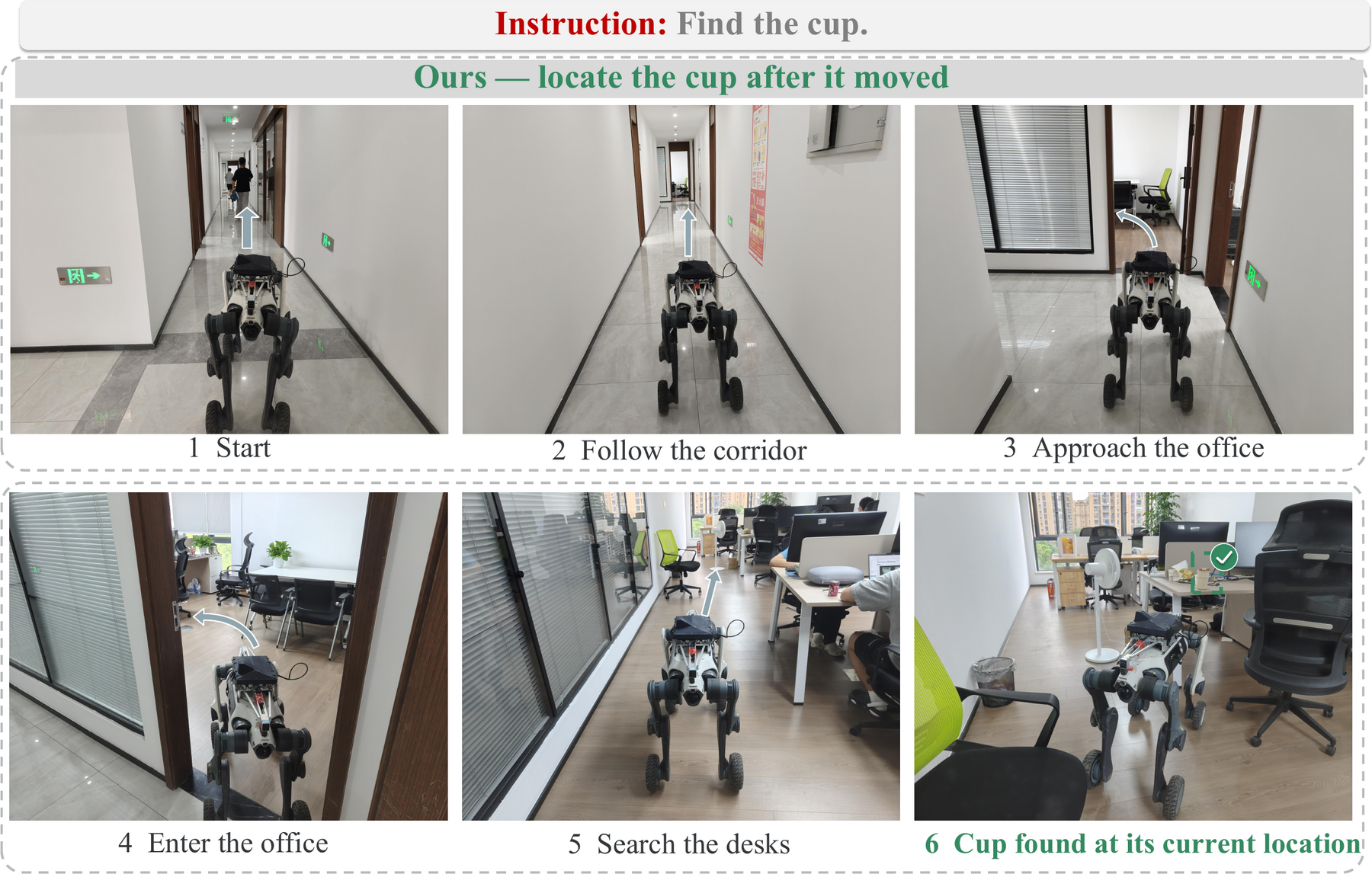
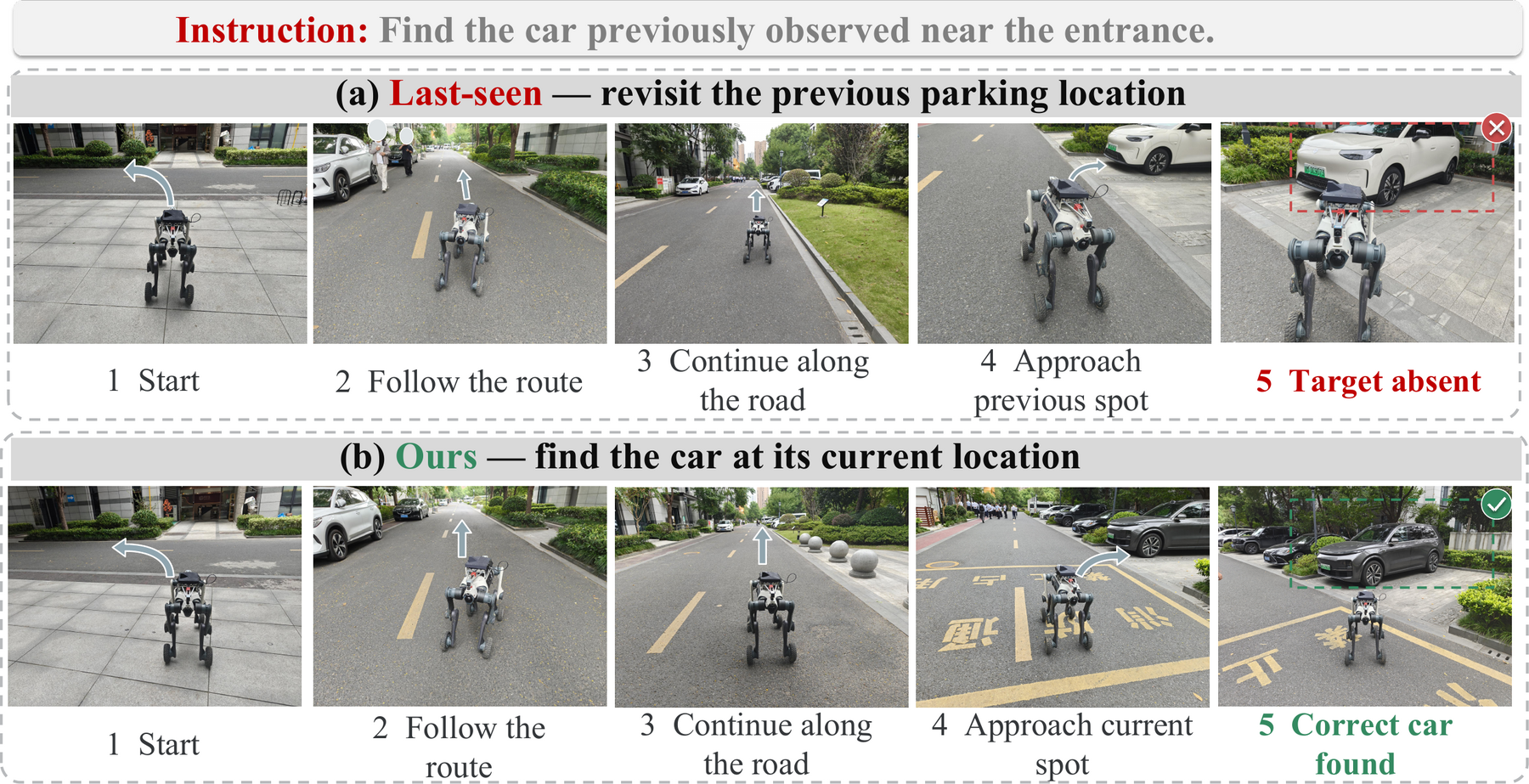
Across 64 matched LYNX M20 search episodes, EvolvingNav reaches 34.4% First-Inspection SR, 48.4% Search SR, and 24.3% Recovery SR, with 43.8 m mean travel.
@inproceedings{evolvingnav2027,
  title     = {Beyond the Remembered World: Predictive 4D Belief for Persistent Navigation in Evolving Worlds},
  author    = {Gao, Mingjian and Li, Zhaocheng and Huang, Haoyang and Zhang, Wenqiao and Niu, Yingjie and Zhou, Hao and Li, Chao and Li, Juncheng and Tang, Siliang and Zhuang, Yueting},
  booktitle = {International Conference on Learning Representations},
  year      = {2027}
}